The Practice of Yang Shen, 養生, Nourishing Life
Have you ever wondered how best protect yourself from illness in the fall? Why you feel like sleeping for long hours in the winter? Or maybe you notice a desire to do a seasonal cleanse in the spring? We are all at the mercy of the seasons, and when we live in harmony with our environment our physiology responds and we feel that much more balanced.
The Chinese practice of Yang Shen, 養生, Nourishing Life, is one of ancient origins, with roots in Daoist philosophy. One of the oldest texts in Chinese medical literature from 475-225 B.C, the Yellow Emperor’s Classic of Internal Medicine, talks about how people lived to be 120 years old.
They, “followed the pattern of heaven and earth…ate and drank with moderation on a regular basis. They worked hard but avoided excessive fatigue. For this reason their spirits and bodies always remained in perfect harmony with each other.” -Su Wen, Chapter 1
Known as the 7th century “great physician,” in Chinese medical history, Sun Simiao, broadened the reach of longevity practices to reach not only male physicians of the time, but also brought in knowledge of the female body and the needs of pediatric patients. In one way, he spearheaded the packaging of preventative medicine into a clear set of practices that could be performed regularly for health.
Spring is the Season For Dancing
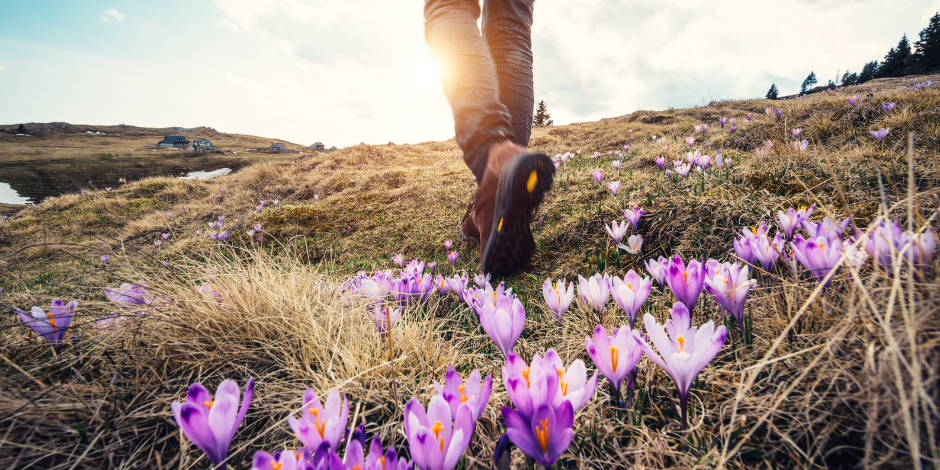
Spring is the season of free and easy wandering. A period of growth, where sprouts emerge only after having spent the winter tending to their roots. The constricting cold starts to loosen its grasp and the warmth invites us out of our dens where we’ve been stewing in reflection. Tis the season for re-emergence and renewal; a time to move again, dance, breath, and stretch. The opportunity is here to shake off the stagnation that’s accumulated from our hibernation.
Spring is associated with the wood element and it’s corresponding organs, the Liver and Gallbladder. These organs belong to one of the 6 stages called, Shaoyang, with denotes one of 2 pivots. Just like a door hinge allows for the opening and closing of the door, the Liver and Gallbladder allow for the pivoting of the upward and downward flowing energies of the tendons and joints. These channels and organs help us to move forward, both physically and metaphorically. They govern the sides of the body and when out of balance, manifest as anger, irritability, and agitation.
If you already have a tendency towards these emotions or feel pain in this body area, you might notice they flare more in the spring time. These are indicators that you are experiencing “wood excess” and should balance the upward springtime energy with the grounding energy of the earth. Another way to work with excess wood is to use the fire element. Use your fire by engaging in aerobic exercise or enjoying time in the sun.
If winter is the season for reflection and hibernation, then spring is the season for dancing. Check out this blog on health-supporting practices during the winter months and how to transition from this month if you are feeling stuck.
Weather Patterns In Spring
Spring as a complete season has its themes, which are often translated through imagery, cosmology, and symbolism in Chinese thought. Some examples of this are spring’s association with the eastern direction, the blue-green dragon, and with wood energetics as aforementioned. It lasts from February 3rd to May 5th. Like a baby sprout or a tree, this season is all about growth; being rooted into the ground and nourished by our reflective winter time, so that we can burst forth towards the sky with a clear direction.
In the spring, we encounter primarily wind, heat, and rain. These weather patterns in spring are in a state of flux, making the season seem erratic. In the early spring months, there is the potential for frost to inhibit or stifle plant growth. This spring, in 2026, the year of the fire horse, we are expected to have a particularly wet spring. This is because, despite the fire energetics of the year, Portland, Oregon is a fire deficient locale, creating counteracting patterns within the elemental cycle. These notes are a window into the complexity and nuance that encompass the Wu Yun Liu Qi.
What Are The Wu Yun Liu Qi?
These are the “Five Movements and Six Qi.” This theory was first explained in the Huangdi Neijing Suwen, Yellow Emperor’s Inner Classic. It spells out the effects of calendrical cycles on human health, and gives insight to the resonance between the human microcosm and the macrocosm.
They are a part of ancient Daoist sciences that are able to understand weather patterns for the year ahead based on the Chinese astrology and geographic elements of the land. For example, one year, the spring may be much colder in the beginning, cautioning against starting young plants too soon. Another year might bring strong winds and warmth, which may be the vector for epidemic disease. These “predictions” are meant to inform health practices, herbal medicine, and agricultural practices.
Spring Winds
Wind is the harbringer of change, for better or for worse. It is movement and can sometimes be erratic and unpredictable. Wind energy brings wildfires, tornadoes, and hurricanes. And when paired with heat, it can be the vector a bad flu. Things to watch out for in the spring are allergies, rashes, and acute illnesses with fevers. All of these are manifestations of wind and heat. Later in this article, you’ll find longevity practices can be performed to support the body in remaining healthy during this seasonal transition and beyond.
Going deeper beyond the general weather patterns of this time, there are the nuances of each month and each 2 week period that the season. The Jie Qi, are these two week periods where, certain keynotes happen in nature: bugs come out, certain flowers bloom, or birds migrate. We can tend to certain areas of health and organ networks during these times to prevent illness later on.
Seasonal Nodes “Jie Qi” in the Spring
These seasonal nodes are like check points. They are an opportunity to check in regularly with ourselves and the changes in the world around us. They can act as jumping off points for reflection: what are you noticing is different about weather patterns with spring? How are the birds, plants, insects and people around you acting? What is going on inside you that seems to be aligned with these natural cycles?
- February 18-20th to March 5-7th: Rainwater, Yu Shui
A time to promote circulation of qi and blood in the meridians and prevent invasion of wind - March 5-7th to March 20-21st: Waking of Insects, Jing Zhe
A time to regulate San Jiao and Gallbladder and harmonize the Pericardium - March 20-21st to April 4-6th: Spring Equinox, Chun Fun
A time to regulate yin and yang and the ascending and descending of the Liver and Gallbladder Qi to adapt to the changing season - April 4-6th to April 19th-21st, Clear & Bright, Qing Ming
A time to smooth the qi and prevent stagnation of Liver Yang - April 19-21st to May 5-7th, Grain Rain, Gu Yu
A time to dispel Liver Wind & harmonize the Spleen and Stomach
If you are new to Chinese medicine, the above language may seem foreign. Continue reading to learn a little bit more about the spring and ways you might interact with these nodes. You can also talk to your acupuncturist or read more about Chinese medicine in the book The Web That Has No Weaver by Ted Kaptchuk.
For part 2, click here.
References
- Maoshing Ni. The Yellow Emperor’s Classic of Medicine : A New Transl. Of the Neijing Suwen with Commentary. Shambhala; 2011.
- Bisio T. Eight Winds in the Heavens: Seasonal Health Secretes and Qi Gong Exercises from Daoist Sages that Prevent Disease and Promote Optimal Health and Vitality; 2024.
- Goldsmith E, Klein M. Nutritional Healing with Chinese Medicine : +175 Recipes for Optimal Health. Robert Rose Inc; 2017.
Meet the Author
 Miquella Young is a naturopathic doctor and licensed acupuncturist whose main goals are to dive into the deeper messages that lie beyond her patients’ pain, trouble sleeping, anxiety, or depression. She understands that many people may have the same diagnosis as each other, but maintains that the way they express that diagnosis is unique to them. Dr. Young focuses more on her patients’ unique expressions, habit patterns, and cycles of illness and health than the disease labels they have been given.
To schedule an appointment with Dr. Young, call 503-956-9396 or contact us now to schedule an appointment today.