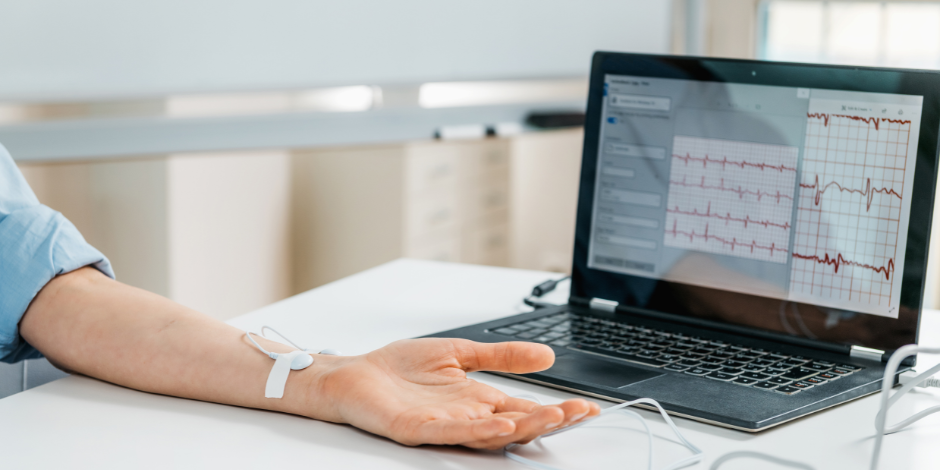
Biofeedback therapy is a non-invasive technique that helps you gain greater awareness and control over your body’s physiological functions using real-time feedback from your body. Sensors are used to measure your heart rate variability, breathing, temperature, sweat response, and muscle tension, providing us with important signals from your body about the state of your nervous system.
How Your Nervous System Finds Balance
 You may have heard of the term “fight or flight” which is the nickname physiologists use to describe the sympathetic state of your autonomic (or involuntary) nervous system. In this state, the body responds by increasing heart rate, dilating airways, and mobilizing energy. Your parasympathetic state, or the “rest and digest” state, contrastingly slows the heart rate, enhances digestive function, and supports recovery and maintenance of body processes.
We need both aspects of our nervous system for survival– your body is wisely equipped with both for good reason. Unfortunately, the chronic stressors of modern life often cause our nervous system to shift into a sympathetic state more often than is helpful. Biofeedback helps us identify when this shift is occurring and allows us to explore simple interventions for addressing these shifts in the moment.
Temperature, Sweat Response, and the Sympathetic State
Two examples of in-office measurements include peripheral temperature and sweat response. These both give us key information about the upregulation of your sympathetic nervous system. As we shift into a sympathetic state, we have less blood flow circulating in the periphery of our body due to the constriction of blood vessels controlled by your sympathetic nervous system. Your body is intelligently designed to shunt your blood to large muscle groups in the event you need to fight (or flee) for your life. Our sympathetic state may also increase the sweaty response on your finger tip. If you’ve ever had sweaty palms before a public speaking event, a first date, or while taking an important exam, you may be able to relate. By looking at these key measurements in the office, we can better understand these aspects of your individual stress response.
Heart Rate Variability and the Parasympathetic State

Heart rate variability (HRV) is the measurement of the variation in time between heartbeats and is correlated with parasympathetic tone. Low HRV is correlated with cardiovascular diseases like cardiac insufficiency, hypertension, coronary heart disease, metabolic disorders, and many others(1). Increasing HRV and parasympathetic tone helps your body more frequently access a state that is conducive to rest, recovery, and healing. Just as you strengthen a muscle through consistent exercise, improving HRV requires regular practice. With HRV training, you may notice increased physical and emotional resilience over time.
What Conditions Does it Address?
Biofeedback has been shown to be particularly effective for managing stress-related conditions which, one could argue, are many. Common conditions that may benefit include:
- Anxiety
- Depression
- Insomnia
- Headaches
- Digestive issues (IBS, constipation, abdominal pain)
- High blood pressure
 Heart Rate Variability (HRV) biofeedback has been shown to improve both mental and physical health. In a randomized controlled trial of 55 anxious students, HRV biofeedback significantly reduced anxiety and altered brain activity compared with controls.(2) In adolescents with inflammatory bowel disease, a group-based HRV biofeedback program reduced gastrointestinal symptoms and perceived stress.(3) Early research also suggests benefits for chronic fatigue syndrome following Long COVID, highlighting its potential as an adjunctive therapy for a variety of stress-related conditions.(4)
Many other conditions may also improve with a series of biofeedback therapy. If you’re wondering whether this approach is right for you, talk to your healthcare provider to learn more.
Schedule a consultation today.
Acknowledgements
Thank you Dr. Paul Dompé of Bastyr University, my biofeedback mentor, whose guidance was instrumental in shaping the educational concepts shared here.
References
- Mück‐Weymann M, Bartels D. Update: Factors Influencing Heart Rate Variability—A Narrative Review. Front Physiol. 2024;15:1430458. doi:10.3389/fphys.2024.1430458.
- Saito R, Yoshida K, Sawamura D, Watanabe A, Tokikuni Y, Sakai S. Effects of Heart Rate Variability Biofeedback Training on Anxiety Reduction and Brain Activity: a Randomized Active-Controlled Study Using EEG. Appl Psychophysiol Biofeedback. 2024 Dec;49(4):603-617. doi:10.1007/s10484-024-09650-5.
- Rea K, Robbertz A, Westbrook A, Buzenski J, Reed B. Biofeedback-enhanced cognitive–behavioral therapy delivered virtually to youth with inflammatory bowel disease: a randomized controlled trial. Inflamm Bowel Dis. 2025;izaf061. doi:10.1093/ibd/izaf061.
- Cossu G, Kalcev G, Primavera D, Lorrai S, Perra A, Galetti A, Demontis R, Tramontano E, Bert F, Montisci R, et al. The Use of Heart Rate Variability-Biofeedback (HRV-BF) as an Adjunctive Intervention in Chronic Fatigue Syndrome (CFS/ME) in Long COVID: Results of a Phase II Controlled Feasibility Trial. J Clin Med. 2025;14(15):5363. doi:10.3390/jcm14155363.
Meet Dr. Nelson
 Sarah Nelson is a naturopathic doctor dedicated to the science and art of healing, as well treating the whole you. She works closely with the mind-body connection, and believes the most effective treatments include the integration of her patients’ physical, mental, and spiritual well-being. Her approach is both curious and nonjudgmental in nature.
To schedule an appointment with Dr. Nelson, call 503-956-9396 or contact us now to schedule an appointment today.