
Qigong (Chee-gong) is a cultivation practice from ancient China that involves periods of movement & stillness, but also includes breath work, tapping, and shaking. These strategies are put together into forms, or clusters of movements, all of which are tied together by a single intention.
In its most basic translations, qì means energy and gong means movement. Making qigong a practice of moving energy. If we consider the layers of symbolism behind the images that represent the Chinese characters for qì and gōng, then we see that there is a deeper meaning of qigong as well.
The Chinese character for qì (氣) depicts the image of the steam that comes up from cooked rice, while the character for, gōng (工), can also mean work, or skill. Rice represents a staple food and key building block of living organisms. To do qigong is to do the work of cooking the rice; turning the basic building blocks of life into a digestable, nourishing form for our bodies.
In this way, qigong asks us to slow down and think about how we are nourishing our bodies. During the practice, we build our awareness, as well as inner resources of calm, stability, and resilience in the face of a challenge.
How Does Qigong Work?
Qigong is a gentle form of movement that can be used to promote balance, strengthen joints and muscles, stretch and strengthen tendons, and calm your nervous system.
In Chinese medicine, one way to understand illness is through the organ and meridian systems. If we distill down the root cause of disease, it is a blockage of qi flow.
Working with qì in qigong opens up these blockages; the superhighways of nerves, muscle, fascia, and blood vessels are cleared of any debris and your body’s resources can flow freely to the organs.
Qì comes in many forms, it’s not only in the food we eat, but the air we breathe, and it constantly flows through our body in pathways called meridians. In qigong, we work with these various forms of qì to move stagnation in the body and cultivate an overall sense of health and wellbeing. The practice will leave you feeling calm, but energized.
How can Qigong help you?
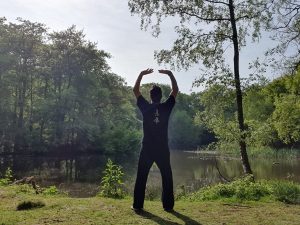 Imagine your body like a landscape. If you’re feeling unwell, the terrain might be challenging with many mountain peaks and valleys, and storm clouds above. Qigong can help to modify your inner terrain so that the clouds overhead are less dense, and the sun is there to light your healing path.
It is also known to support your body with:
- Stress Reduction
- Balance & Mobility
- Sleep Quality
- Cognition and Memory
- Mood Stability
- Quality of Life
- Lung Function
Qigong is a safe, low-impact activity that is typically practiced standing, but can also be practiced sitting. The practitioner guides the group through a form, which includes periods of gentle walking, weight shifting, and arm movements, all of which are synchronized with the breath, are alternated with periods of stillness in different postures. Breath work, tapping, visualization and shaking are also techniques used throughout the practice. The practice can be modified for various skill and ability levels. Though many conditions can also be supported by a regular qigong practice, the following conditions have research to support the use of qigong for treatment.
Research Shows that Qigong Can be A Supportive Approach for the Following Conditions:
- Parkinson’s Disease
- Depression
- Anxiety
- Neck Pain
- Fibromyalgia
- COPD
- Hypertension
- Chronic Heart Failure
- Fall Prevention
- Cancer (improve quality of life and reduce side effects during treatment)
- Substance Use Disorders
Meet the Author
 Miquella Young is a naturopathic doctor and licensed acupuncturist whose main goals are to dive into the deeper messages that lie beyond her patients’ pain, trouble sleeping, anxiety, or depression. She understands that many people may have the same diagnosis as each other, but maintains that the way they express that diagnosis is unique to them. Dr. Young focuses more on her patients’ unique expressions, habit patterns, and cycles of illness and health than the disease labels they have been given.
To schedule an appointment with Dr. Young, call 503-956-9396 or contact us now to schedule an appointment today.
References
- Chang P-S, Knobf T, Oh B, et al. Physical and psychological health outcomes of qigong exercise in older adults: a systematic review and meta-analysis. The American Journal of Chinese Medicine. 2019;47(2):301-322.
- Chen S, Zhang Y, Wang YT, et al. The effect of qigong-based therapy on patients with Parkinson’s disease: a systematic review and meta-analysis. Clinical Rehabilitation. 2020;34(12):1436-1448.
- Chen X, Savarese G, Cai Y, et al. Tai chi and qigong practices for chronic heart failure: a systematic review and meta-analysis of randomized controlled trials. Evidence-based Complementary and Alternative Medicine. 2020;2020:2034625.
- Ching SM, Mokshashri NR, Kannan MM, et al. Effects of qigong on systolic and diastolic blood pressure lowering: a systematic review with meta-analysis and trial sequential analysis. BMC Complementary Medicine and Therapies. 2021;21(1):8.
- Girard J, Girard A. The effects of qigong on neck pain: a systematic review. Complementary Therapies in Clinical Practice. 2019;34;23-29.
- Gouw VXH, Jiang Y, Seah B, et al. Effectiveness of internal qigong on quality of life, depressive symptoms and self-efficacy among community-dwelling older adults with chronic disease: a systematic review and meta-analysis. International Journal of Nursing Studies. 2019;99:103378.
- Ji ES, Han H–R. The effects of Qi exercise on maternal/fetal interaction and maternal well-being during pregnancy. Journal of Obstetric, Gynecologic, and Neonatal Nursing. 2010;39(3):310-318.
- Klein PJ, Baumgarden J, Schneider R. Qigong and tai chi as therapeutic exercise: survey of systematic reviews and meta-analyses addressing physical health conditions. Alternative Therapies in Health and Medicine. 2019;25(5):48-53.
- Liu S–T, Zhan C, Ma Y–J, et al. Effect of qigong exercise and acupressure rehabilitation program on pulmonary function and respiratory symptoms in patients hospitalized with severe COVID-19: a randomized controlled trial. Integrative Medicine Research. 2021;10(Suppl):100796.
- Sawynok J, Lynch ME. Qigong and fibromyalgia circa 2017. Medicines (Basel, Switzerland). 2017;4(2):37.
- Tang SK, Tse MMY, Leung SF, et al. The effectiveness, suitability, and sustainability of non-pharmacological methods of managing pain in community-dwelling older adults: a systematic review. BMC Public Health. 2019;19(1):1488.
- Toneti BF, Barbosa RFM, Mano LY, et al. Benefits of qigong as an integrative and complementary practice for health: a systematic review. Revista Latino-Americana de Enfermagem. 2020;28:e3317.
- Van Vu D, Molassiotis A, Ching SSY, et al. Effects of qigong on symptom management in cancer patients: a systematic review. Complementary Therapies in Clinical Practice. 2017;29:111-121.
- Wu J-J, Zhang Y-X, Du W-S, et al. Effect of qigong on self-rating depression and anxiety scale scores of COPD patients: a meta-analysis. Medicine (Baltimore). 2019;98(22):e15776.
- Zeng Y, Xie X, Cheng ASK. Qigong or tai chi in cancer care: an updated systematic review and meta-analysis. Current Oncology Reports. 2019;21(6):48.